
History of the ECSCA Logo & Maquette.
The Museum of the Dog Acquires a Piece of English Cocker Spaniel History
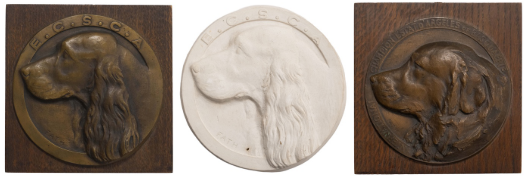
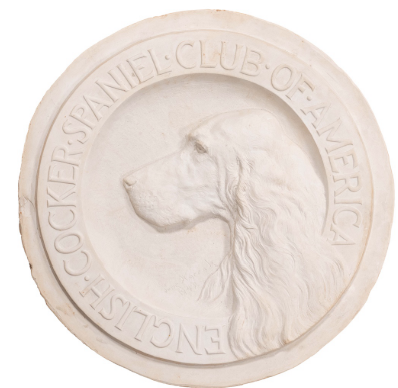
Those who were fortunate enough to visit Kate Romanski, in Hales Corners, Wisconsin, were treated to a piece of breed history. Hanging on the wall above the stack of Kennel-Aire crates in the living room, was the maquette created by Miss June Harrah, commissioned by Mrs. Geraldine R. Dodge. At the 1942 annual meeting of the ECSCA, Mrs. Dodge submitted for inspection the bronze bas-relief of the ideal English Cocker head. Approval was given and Mrs. Dodge was asked to purchase the original.
A year later the members present at the 1943 annual meeting quickly approved the purchase of fifty of the new medallions for $3.00 each from the Medallic Art Company in New York City, to which Mrs. Dodge had given the task of casting the bas-relief into bronze. The medallions were to be awarded to dogs and bitches which completed their championships.
As an aside, twenty-two of these medals were stolen from the home of Ethywyn Harrison in 1945, and were never recovered (perhaps they will be found on eBay!) Mrs. Dodge had the Medallic Arts Company in New York make several more, and the tradition of awarding a medal to those dogs completing a championship title continues to this day. In 1998 due to cost considerations, pewter medallions were made by the Bergamont Company in Wisconsin.
But I digress. Back to the maquette.
I am not sure how June Harrah's maquette found its way to the William Secord Gallery, but it was eventually purchased by Kate Romanski. I have a vague recollection of Kate telling me how it had been initially purchased by a French buyer, but somehow Kate was able to intervene and take possession before the maquette would be lost forever on European shores.
Prior to Kate's passing in 2023, she had asked me to make sure that the maquette would find its rightful home with the AKC Museum of the Dog. I was finally able to make good on my promise to Kate. In February, I contacted Alan Fausel, an adjunct curator at the museum. He and Kate had corresponded over the years and Alan was well acquainted with the piece. Alan is not only a distinguished art scholar but a celebrity — those of you who are familiar with The Antiques Roadshow will recognize his face. And he is an English Cocker owner!
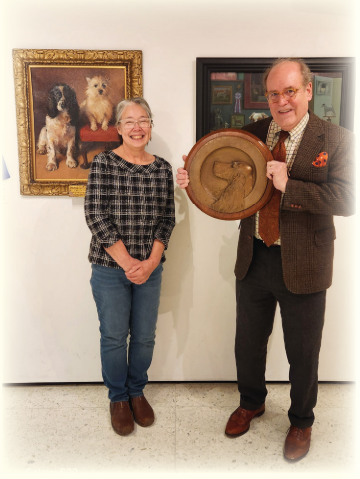
The AKC Museum of the Dog is full of English Cocker history and art. I would urge that when visiting New York City, you take the time to visit the museum and submerge yourself in all things dog, and in particular, the English Cocker treasures!
They Might Be Giants
The much-appreciated donation of Geraldine Rockefeller Dodge's personal English Cocker Spaniel Club of America (ECSCA) medallion by June Harrah from the estate of Kate Romanski, brings into focus several towering figures associated with the breed, including Mary Crane, who may have sponsored perhaps the first ECSCA medallion.
Geraldine Rockefeller Dodge
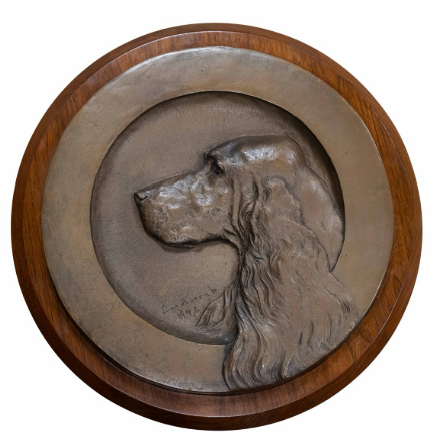
Mrs. Dodge, with her vast resources of land, wealth, renowned kennels, and, of course, the Morris & Essex Dog Show, was arguably one of the most influential figures in 20th-century dogdom. Of the many breeds she admired, none benefited more from her advocacy than the English Cocker Spaniel. She was instrumental in promoting the breed as distinct from its American cousin, establishing its independent parent club in 1935 and ultimately helping secure AKC recognition eleven years later.
In 1942, Mrs. Dodge enlisted sculptor June Harrah to memorialize the breed in the form of a bronze medallion featuring the portrait head of the English Cocker Spaniel.
June Harrah
By the time of this commission, Harrah had already established herself as one of the preeminent canine sculptors of her era. Her seminal 1936 edition of forty-nine small-scale bronzes depicting many of the most famous dogs of the day demonstrated both her technical mastery and her keen understanding of canine form. Selected by Anton Rost, the subjects collectively provide a fascinating window into the show dog world of the early 20th century. Harrah's life-sized bronze of the Newfoundland Ch. Dyad's Strong Sea Pirate still welcomes visitors to the Museum at its entrance.
Mrs. Dodge presented Harrah's proposed sculpture at the ECSCA annual meeting in 1942. The following year, the club approved the production of fifty small-scale medallions to be awarded to champion dogs and bitches, along with a limited-edition large-scale version. The dog who sat for the portrait was reportedly Mrs. Dodge's red dog, Giralda Jack.
— Geraldine Rockefeller Dodge
The choice of a profile portrait may have followed the conventions of medallic art and coinage, but fittingly, it is the head of the English Cocker Spaniel that most clearly distinguishes it from the American breed.
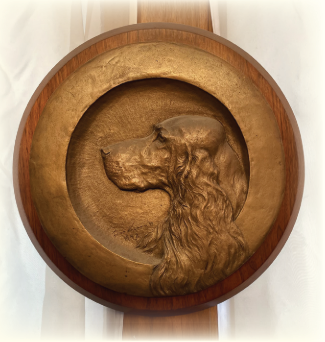
In 1998, the ECSCA donated June Harrah's original 13¼-inch plaster maquette to the Museum. It is most likely the final version from which molds were made and bronzes subsequently cast. The recently donated bronze is identical in size and composition to the plaster, though it lacks the surrounding inscription. One can reasonably speculate that the bronze represents an earlier iteration of the final design, prior to the inclusion of the club's name.
When Mrs. Dodge first proposed the medal in 1942, the board did not authorize production until the following year, at which point the addition of the club name was approved. Further supporting this theory is the work's provenance: Kate Romanski acquired the bronze from the William Secord Gallery around 2010. While most of the contents of Mrs. Dodge's Giralda Farms were dispersed through a series of monumental sales in 1975, a small number of objects remained with her charity, St. Hubert's Giralda, and were sold decades later through Mr. Secord. The provenance, coupled with the absence of the inscription, strongly suggests this may have been the first Harrah bronze of the series, and perhaps even from Mrs. Dodge's personal collection.
Mary Crane
Mary Crane's lifelong devotion to the Great Pyrenees breed through her Basquarie Kennels has, to many, overshadowed the fact that she was also a charter member of the ECSCA and bred English Cockers in the club's earliest days. Though she would later devote herself almost entirely to establishing the Great Pyrenees in America, she remained a respected English Cocker judge throughout her life.
Just prior to the Second World War, Mrs. Crane traveled extensively through France identifying and selecting champion Great Pyrenees for her kennels, driven in part by the fear that another world conflict would devastate Europe's breeding programs as the previous war had done. During her travels she became acquainted with the sculptor Richard Fath. Museum visitors may recognize his striking pair of coursing Greyhounds, seemingly suspended impossibly in midair.
In 1936, Mrs. Crane commissioned Fath to create a standing sculpture of the famed International Champion Estat d'Argelès, as well as a 4½-inch portrait medallion of the dog. Apparently, around the same time, she also commissioned him to design a medallion for the ECSCA. The AKC Museum of the Dog retains a five-inch bronze example, along with no fewer than three plaster maquettes by the artist. Little documentation survives regarding the circumstances of their production, though they almost certainly stem from Mrs. Crane's association with Fath in 1936.
In her monograph The Great Pyrenees, Mrs. Crane noted that the bronze medallions featuring Estat's head "…were awarded to winners of three-point shows until the supply became exhausted in 1940." One may reasonably assume that a similar fate befell the Fath ECSCA medallions, with wartime realities ultimately leading Mrs. Dodge to commission a new medallion from the American sculptor June Harrah.
Kate Romanski
Kate Romanski was among the last links to the founders of the English Cocker Spaniel in America. For many years she served as secretary and historian of the ECSCA and, together with Beth McKinney, authored the four volumes of The English Cocker Spaniel between 1986 and 2000.
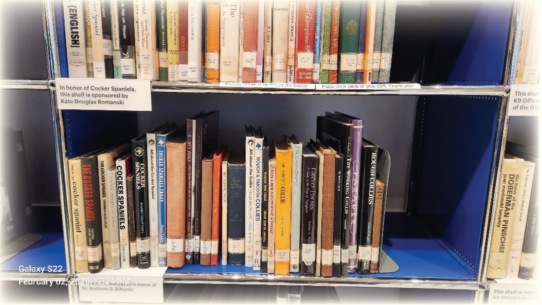
My own association with Kate began in 2020, shortly after she donated thirty-three boxes of archival material to the AKC Library & Archives while also financially supporting the Cocker Spaniel shelves within the Museum's library. In the lead-up to the Morris & Essex show, postponed until 2021, Wayne Ferguson circulated a list of about a dozen surviving members of the fancy who had attended the last original Morris & Essex in 1957. Kate's name appeared alongside legendary figures such as Wendell Sammett.
Over the following year, Kate and I shared many long and thoroughly enjoyable conversations. The Museum hoped to bring her to the show to be honored, though ultimately, because of her failing eyesight, she worried she would be embarrassed not to recognize old friends and acquaintances. Still, in nearly every conversation she gently reminded me that Mrs. Dodge's medallion was headed our way.
While we are deeply grateful to welcome this remarkable acquisition into the collection, I miss those conversations even more.
Members visiting New York are encouraged to explore its remarkable collection of English Cocker art and history.
museumofthedog.org